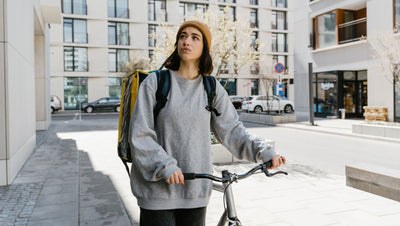
Our ambassador Marie-Pierre Savard says winter biking is something worth trying.
For about twenty years now, cycling has been my preferred mode of transport, 12 months a year! During my travels in urban areas, I realized that riding in winter is not a feat reserved for extreme athletes. It is, above all, a habit accessible to anyone who wishes to step out of their comfort zone.
Of course I've difficult, even dangerous moments, but the kilometers taught me and, today my approach is different... My safety is my priority! I am not in such a hurry and, if I don’t feel it, I opt for a Plan B to move around. In this way, winter commuting remains a pleasure rather than an insurmountable challenge. The following text therefore wishes to convince you that it is more accessible than one believes.

Aren’t you too cold on your bike?
That’s the question I get asked most often when I show up with my winter bike set! And my answer is no: most of the time, I’m not even cold! Urban biking is a dynamic activity. Between monitoring traffic, braking and accelerating, I don’t really have time to be cold on a thirty-minute journey. At first, each outing was a learning about the number of layers to wear, until I found my ideal combinations according to the announced temperatures.
My essentials
My first hardware-level advice: use what you already have and adapt afterwards, one problem at a time! Go in layers instead of overly warm clothes and don’t invest in overly sophisticated pieces or equipment, as winter is harsh on gear.
-
Bikes: For my daily city commute, I love my old singlespeed. It doesn’t look like much, and with only one speed, goodbye rusty derails and gears that freeze! It is easy to maintain, comfortable and fun to ride.
- Tires: Having good traction is necessary to gain confidence and feel safe. As an indication, currently I ride with a studded tire at the front (Schwalbe Winter 26 x 1.75) and a studded tire at the rear (Schwalbe Marathon 365 26 x 1.75). However, for a long time I had much narrower cyclocross tires and they worked well! I also have to adjust (quite often) the pressure of my tires according to the surface of the day, in order to have more (or less) traction.
- Fenders: Essential to stay dry, even if I’m not a big fan! I opted for plastic models, wide and removable, which leave enough space to prevent the snow from accumulating. I especially like the fact that I can remove them easily!
- Mirror: It was only last winter that I decided to get a mirror, since my new helmet restricted my side vision a bit. This little gem almost gives me eyes all around my head and allows me to better see the cars that arrive without having to divert my gaze from the road. A must that I can no longer do without.

See and be seen:
In winter, the brightness drops quickly and the visibility of road users is reduced. Between my quick movements to avoid potholes and ice patches and rushed motorists, I want to make sure to see (with my rechargeable USB headlights) and be seen! Clothes with bright colors, reflective strips, and especially the Arkel Signature D 'Hot Orange' bag that screams 'Do you see me?'! I am not embarrassed to look like a Christmas tree if it allows me to feel safe!
Logistics, security and flexibility
Getting around in winter requires a bit more organization, but it quickly becomes a habit. Planning a change of clothes or checking the weather when waking up to choose the clothing of the day are now integrated into my daily routine!
Winter trips also require a good dose of flexibility: I often modify my routes according to the maintenance of the paths and the condition of the road. Making a detour to take a wider or better snow-cleared street is well worth it for my peace of mind, even if it extends the journey by 5 minutes.
That said, driving in winter is not always calm. When the weather is extreme or the conditions are disastrous, I don’t hesitate to choose an option B to move. This year, I found the winter more tiring, to the point of using a share car almost every week. Cycling remains my first choice, but removing the obligation to be a perfect example of active mobility allows me to continue loving my practice. It must remain a pleasure, not an achievement to prove at all costs.

More than transport: a healthy habit
Beyond time and CO2 savings, the winter bike has made me a better cyclist... and a better motorist! My reflexes are sharper, I feel more in control of my bike and the icy and snowy roads make me much less afraid. My wish? That the winter bike is no longer considered as an achievement, but as a real alternative. And to do this, it takes quality infrastructure, well maintained 12 months a year, so that each person can feel safe using them.
Marie-Pierre Savard
P.S.: To learn in a structured setting, the Vélo Québec winter bike mentorship program is a very relevant resource. Free and available in several regions, it pairs experienced cyclists with novices to "break the ice" confidently.